|
Prosticks Articles
Apple Daily --- 3 Sept, 2000
Modal Point by Time
Today we will apply Prosticks concepts to analyze the
behaviour of the Hang Seng Index.
Notice that the Hang Seng Index is not a traded
instrument. Thus, it contains no volume information.
Therefore, in order to calculate its Modal Point and
Active Range, we use a time approach. In the time
approach, instead of identifying which price contains the
highest volume traded at it, we identify the price which
the market spends the most time on. Specifically, the
computer will keep track of all the tick prices the Hang
Seng Index has updated on the quote screen. The Modal
Point is the price which has the highest updating
frequency. Similarly, the Active Range is the price range
which the index has fluctuated most of the time throughout
the day. This time approach to keep track of trading
activities for indices and futures is originated from
Market Profile theory and has been widely adopted by
institutional traders and big money guys.
The time approach can be applied to stocks in the same
way. There are several advantages of using the time
approach to calculate Modal Points instead of the volume
approach. First, as said before, indices and currencies
have no volume information. The time approach is the only
option. Secondly, sometimes volume information can be
misleading, especially for block transactions which
bypassed the brokers? queue. Should such volume be counted
towards Modal Point computation? Thirdly, think about
this. Suppose a stock opens gap down at $100 and then a
huge volume (let say 1 million shares) changes hand
immediately at $100 within 2 minutes, much of which are
overnight stop-loss trades. Then suddenly the stock
rallies all the way to $110 and most of the time in the
remaining session it trades in a narrow range at $110 with
a total volume of $0.8 million. In this case, we would
agree that though more volume is traded at $100, $110 is
the true Modal Point. The market spends only two minutes
at $100 but nearly the whole day at $110. $110 is a more
important price level. Those volume traded at $100 are
only overnight stop-loss orders which are less
significant.
Our research does indicates that Modal Points computed
using the time approach have more predictive power than
the volume approach. In the Prosticks official website,
Modal Points offered by both approaches are displayed.
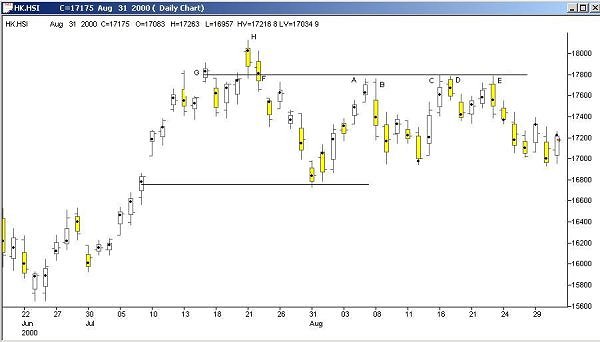
Figure 1 shows the Prosticks chart of the Hang Seng
Index generated using the time approach. As can be seen,
during August, the index has been consolidated in the
16800-17800 range. A, B, C, D and
E are the high points of the consolidation.
Coincidentally, they have near exact price levels as the
Modal Point F and G, meaning that whenever
price attained around 17800 level, selling pressure came
out and these selling pressure were originated from the
Modal Point of F and G. Notice that after
price forms the new high at H, F is the
first bar which starts the correction. As such, after
forming a new high, severe selling pressure from big money
guys rushed into the market, particularly at the Modal
Point of F. Obviously, these selling pressure
resurfaced whenever price rose back to its price level.

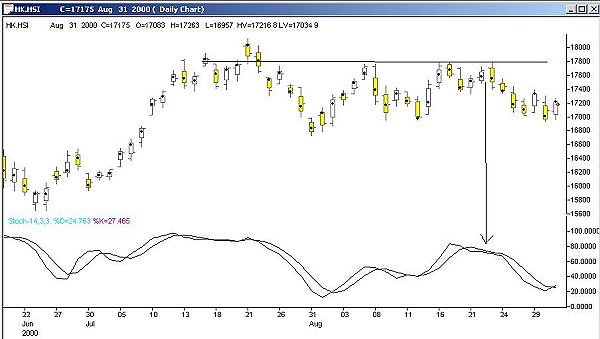
Suppose we are back to day E. Are there anyway
we could forecast during that day that the market is going
to be resisted by the Modal Platform of F and G
when price initially rose to there? Take a look at Figure
2 which shows the Stochastics plot in accompany of the
Prosticks chart. Notice that at E, though the price
has been rising in the previous few days, the Stochastics
is in already overbought region and has already started to
fall, with the fast line below the slow line. This shows
that the market lacks upward momentum. When the market
lacks momentum, it is likely to be resisted by the Modal
Platform instead of penetrating through it.

|