|
Prosticks Articles
Hong Kong Economic Journal --- 28 Aug, 2000
How To Draw Trendlines Using Modal Points
Academic research suggests that the Random Walk Model
cannot be applied to currencies. For currencies,
short-term movements tend to exhibit trending behaviour
while over long-term, price movements tend to be range
trading. Thus, seasoned currencies traders should be able
to profit consistently in the market if they could master
when to follow trends.
Trendlines are a very popular tools used by trend
followers. There are two kinds of trendlines: support and
resistance lines. When price rises above the resistance
line, theory says that an uptrend will be evolved. By the
same token, when price breaks below the support line, a
downtrend follows.
Let me now illustrate some techniques of drawing
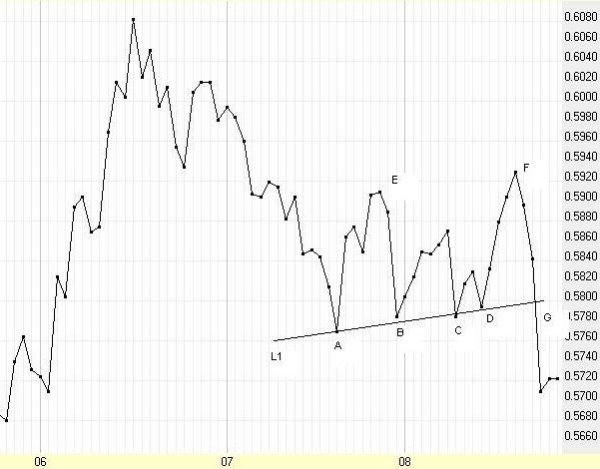
trendlines. Figure 1 shows the Modal line chart of the
Australian dollar. A Modal line chart connects everyday's
Modal Points together. As can be seen from the chart, L1
is a support trendline. Price breaks the trendline at G
and then falls sharply.
A support line is drawn by connecting two nearby low
points together. Notice that all A, B, C,
D are low points. Coincidentally, all of them lie
on the same line L1. Therefore, L1 is a
valid support line. Since L1 connects four lows
instead of two, it is a very strong support line.
Another reason why L1 is a valid trendline is
because of the symmetry of price movements evolved on it.
Notice that the triangle A-E-C and C-F-G are
quite symmetrical in terms of both width and height. When
the two triangles lying on a trendline are symmetrical,
the trendline is an effective one.
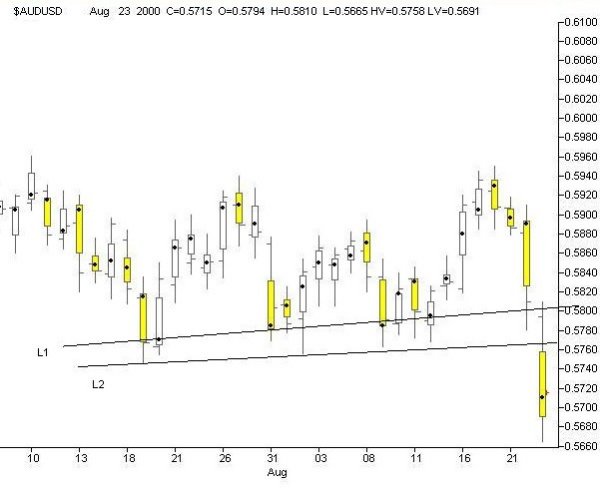
Figure 2 shows the Prosticks chart of Australian
Dollar. L1 is the Modal trendline we drew just now
in Figure 1. L2, on the other hand, is the support
trendline drawn using the traditional approach.
Traditionally, support trendlines are drawn by connecting
two bar lows together instead of the Modal Points. As can
be seen, our L1 has an earlier entry point than L2.
Furthermore, since everybody using the traditional
approach is drawing L2. Therefore, if you sell when
L2 is broken, most probably you will get a very bad
fill since everybody is selling at the same time as you.
On the other hand, if you sell when L1 is broken,
by the time when L2 is breached, you already have a
nice profit in hand and do not need to join the crowd.


|