Apr 29, 2026  1:16:23 PM HKT

TourSiteMapFAQsAboutContact
Home QR  Forex TV 
UsernamePassword
SavePW
sp

  Home > Education > Intro: Technical Analysis & Charting > Chart Analysispatentsp
  
sp
sp
sp
Technical
Chart Analysis
sp
spTechnical
spsp
spTechnical vs. Fundamental
sp
spWhat is Technical Analysis?
sp
spChart Analysis
sp
spIndicator Analysis
sp


sp
spsp
sp

Introduction

Market technicians, technical analysts, and chartists use charts to analyze a security's price action and attempts to forecast future price movements. But charts are not limited to only charting experts. Fundamental analysts can also make use of charts since a graphical historical record makes it easier for fundamentalists to spot the effect key events have on a security's price (e.g. earnings, dividend payout, etc.) and checking a security's performance over time is made a lot easier as well.

Timeframe

The appearance of a chart can come in a variety of forms and can display intra-day, daily, weekly, or monthly data. Daily data is made up of intra-day data that has been compressed to show each day as a single data point. Weekly data is made up of daily data that has been compressed to show each week as a single data point while monthly data is made up of weekly data that has been compressed to show each month as a single data point. The choice of data compression and timeframe depends on the data available and one's trading or investing style.

Traders usually focus on daily and intra-day charts to attempt to forecast short-term price action. Short-term charts are very detailed and informative but can also be very volatile at times due to large sudden price movements, a wide high/low range, and gapping prices.

In contrast, investors usually concentrate on weekly and monthly charts to identify long-term trends for forecasting long-term price movements. Because long-term charts cover a longer timeframe, price movements are more smoothed out with less noise.

A combination strategy is also available. Investors can use long-term charts for analyzing the broader perspective, or trend, of the price action while short-term charts can be used for entry and exit points.

Chart Types

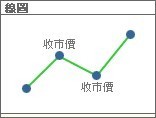
There are a few types of charts that technicians, technical analysts, and chartists rely on and the line chart is one of the simpler ones. It can be produced by plotting one price point, usually the close, of a security over a period of time. Connecting all of the price points creates the line. Due to the, sometimes volatile, intra-day action, the close is the preferred price of many for creating a line chart, rather than the open, high, or low.

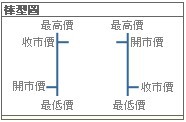
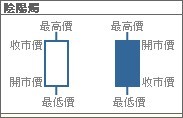
LineBarCandlestick

Arguably the most popular chart in use today is the bar chart. The open, high, low and close prices are all required to form the price plot for each period of a bar chart. The high and low are represented by the top and bottom of the vertical bar while the open is the short horizontal line on the left of the vertical bar and the close is represented by the short horizontal line on the right of the vertical bar. The primary reason for the bar chart's popularity over the years is that its skinny appearance allows for more data to be plotted on a chart. Unlike the line chart, the bar chart is more informative by presenting not only the close but the open, high, and low prices as well. Occasionally, some bar chart users will prefer to omit the open price from the plot so that the chart will be less cluttered and easier to analyze.

Used in Japan for over 300 years, the Japanese candlestick charts have become quite popular in recent years. The open, high, low and close are all required to produce the chart. As shown above, the difference between a candlestick and a bar is the area between the open and the close. A white, or clear, body is formed when the close is higher than the open. Alternatively, a black, or dark, body is formed when the close is lower than the open. The lines above and below the body, if any, are referred to as shadows and represent the high and low. The recent surge in enthusiasm of the candlestick charts is primarily due to the chart's easy to read appearance and the easily recognizable relationship between the open and the close.

Price Scales

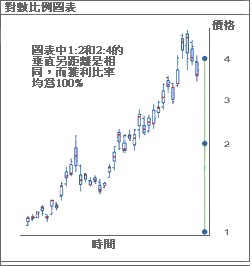
Over the years, technicians have become accustomed with two techniques for displaying the price scale of a chart: absolute and logarithmic. An absolute scale displays the same vertical distance between every price. Each unit of measure is the same throughout the entire scale.

AbsoluteLogarithmic

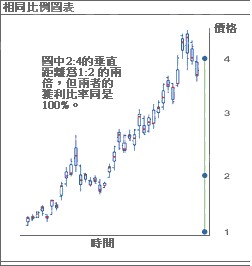
On the other hand, a logarithmic scale measures price movements in terms of percentage move. For example, as illustrated below, a gain from 1 to 2 would represent an increase of 100 percent. Similarly, a move from 2 to 4 would also be a gain of 100 percent. However, both of these advances would be displayed on a logarithmic scale the same in terms of vertical distance. On an absolute scale, the move from 2 to 4 would be twice that of the 1 to 2 move.

So which scale should one use? Absolute scales are most useful when the price is trading in a tight range. Hence, absolute scales can be particularly useful for short-term charts and traders. Conversely, logarithmic scales are best suited for long-term charts and when the price had made a significant move (e.g. technology boom and bust in late 1990s).

Forecasting With Charts

Even though many different charting techniques are available, one method is not necessarily better than the other. Each has its own benefits and drawbacks. One should always keep in mind that the data and price action are the same for all methods. Thus, the choice of which charting method to use will depend on one's preference and trading or investing style. A successful technician will be one that can successfully transform one's own charting preferences to an accurate interpretation of the underlying strength of the security under analysis.


PreviousNext
quote
 Find Symbol
sp

sp
sp
QuickLinks

sp
agreementspprivacysppatent
sp
sp
sp
sp

Copyright© 2026 ProSticks.com Limited. All rights reserved. ProSticks.com Limited, Hong Kong Exchanges and Clearing, HSI Services Limited, endeavor to ensure the accuracy and reliability of the information provided but do not guarantee its accuracy or reliability and accept no liability (whether in tort of contract or otherwise) for any loss or damage arising from any inaccuracies or omission. Currently, all Hong Kong stock and index quotes are at least 15 minutes delayed. Currency and commodity quotes are all 10 minutes delayed. All others are updated irregularly.