Introduction An indicator can be defined as a set of data points that are derived by applying a formula to the underlying price data of a security. Price data includes any combination of the open, high, low or close price over a particular time interval. Certain indicators use only the closing prices, while others may incorporate such elements as time and volume into their calculation. By creating a time series of data points, comparisons and analyses can be performed between current and historical levels. For analyses, indicators are usually plotted above or below, or even overlaying, a security's price chart. Once portrayed in this graphical form, comparisons can then be made more easily with the corresponding price chart of the financial instrument. Indicators, in fact, can help one identify the underlying strength and direction of a security's price action. Having this in mind, one should also take into consideration that indicators are signals, and not direct reflections, of a security's price action. Indicators are primarily used for three reasons: 1. alert, 2. validate, and 3. forecast. - An indicator can help alert one to study closely the price action of a security. If momentum is fading, it may be an early sign of a break of support. On the other hand, if there is a growing positive divergence, it may be an alert to monitor closely the price action of the security as a possible resistance breakout may be on the horizon.
- Indicators can help validate the results of other technical analysis tools. If a breakout to the upside occurs, a corresponding moving average crossover may act as a confirmation of the strength in the price action. Alternatively, if a stock pierces through a support level, a corresponding low in the Relative Strength Index (RSI) may confirm that the sellers have overwhelmed the buyers.
- Indicators can also be used to help investors and traders forecast when to buy and when to sell. However, one should always keep in mind that indicators do generate false buy/sell signals from time to time. Hence, one should always use other technical analysis tools to confirm other indicator's signals.
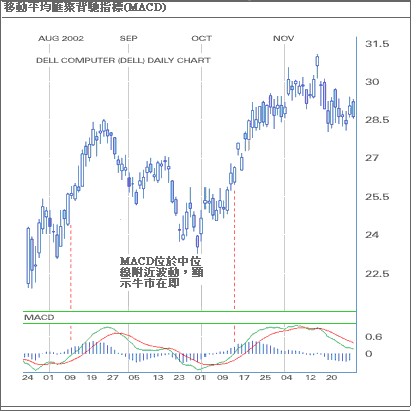
As always in technical analysis, learning how to read indicators is more of an art than a science. Indicators that work well for certain stocks may not work as well for others. Expertise will develop with experience, which in turn will provide the basis for effective recognition of false signals. It is also best to focus on two or three indicators at one time. Attempts to analyze a security with five or more indicators are usually ineffective and frustrating. Try to choose indicators that complement each other, instead of those that generate the same signals. For example, it would be meaningless to analyze two indicators that are both good at providing signals for overbought and oversold conditions, such as the RSI and Williams %R. Most of the time, the results will leave you scratching your head. Leading Versus Lagging Indicators Indicators also come in two varieties: leading and lagging. Leading indicators are designed to help one forecast what the price will do next and can provide a greater return at the expense of increased risk. Hence, false signals and whipsaws tend to occur, more often than not, with these types of indicators. Leading indicators measure how overbought or oversold a security is. This is done with the assumption that overbought securities will retrace and vice-versa for oversold ones. Some of the more popular leading indicators include Commodity Channel Index (CCI), Momentum, Relative Strength Index (RSI), Stochastic Oscillator, and Williams %R. Conversely, lagging indicators are what technical analysts refer to as trend following indicators. These indicators are best when prices move in relatively long trends. They simply inform the technician what the price is doing at the current moment and are not good at predicting into the future. As such, lagging indicators are not effective in trading the bounce back or retracement (i.e. when the market is in a trading range). It follows then that these types of indicators provide signals that are somewhat late, with a significant portion of the move having already occurred. But having said that, investors can still benefit tremendously from relatively long trends by following these types of indicators. Some of the more popular lagging indicators include moving averages (exponential, simple) and the Moving Average Convergence Divergence (MACD) indicator. Oscillators An oscillator is a type of indicator that fluctuates above and below a centerline or within a set range over a period of time. However, oscillators can often linger around the upper or lower boundary of the range (overbought or oversold) for an extended period of time, but they cannot trend persistently. In contrast, indicators that do not fluctuate around a centerline or remain in a range, such as the On Balance Volume (OBV) indicator, can trend continuously for a sustained period of time. In general, there are two different types of oscillators: 1) centered oscillators, which fluctuate above and below a centerline and 2) banded oscillators, which fluctuate between overbought and oversold levels. An example of a centered oscillator is the MACD indicator (below). MACD is the difference between the 12-day and 26-day Exponential Moving Averages (EMA). The higher the difference between the two, the higher the indicator reading. Although there is no bound as to how high or low the MACD value can be, large differences between the two moving averages are unlikely to persist for a long period of time. 
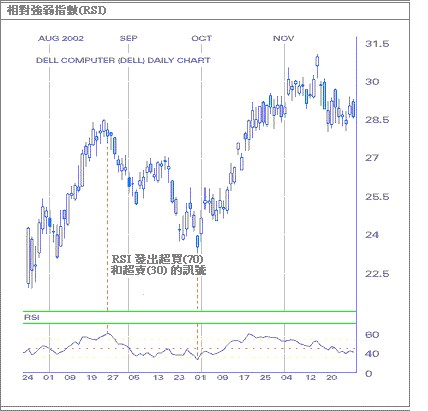
On the other hand, the Relative Strength Index (RSI) is an example of a banded oscillator. Readings in the lower range of the indicator represent an oversold condition while readings at the higher end indicate an overbought condition. 
So which types of oscillators should one use? In general, centered oscillators are best suited for identifying the underlying strength and direction of the price action. Usually, readings above the centerline indicate a bullish presence for the security while readings below it represent a bearish mood. A centerline crossover can also act as validation of a previous signal. For example, if there were a previous buy signal then a subsequent move above the centreline would confirm the previous signal. In contrast, banded oscillators are best suited for the trader, or short-term investor. These types of oscillators are best suited for identifying extreme overbought and oversold conditions in a sideways market and should not be used for trending issues. In a trending environment, many false signals may occur because banded oscillators can remain near overbought or oversold levels for an extended period of time. An overbought condition does not necessarily mean it is a time to sell and vice-versa for an oversold condition. For example, if a security is in a strong uptrend, buying at oversold levels will be much more profitable than selling at overbought conditions. Overbought and oversold situations are best used as a warning that close attention should be paid to the price action as conditions are reaching extreme levels. Divergence  One of the most powerful and widely believed concepts in technical analysis is divergence. It is a key concept behind many indicator buy/sell signals. Divergences can help one identify changes to a trend and also, it can help solidify a buy or a sell signal from other indicators.
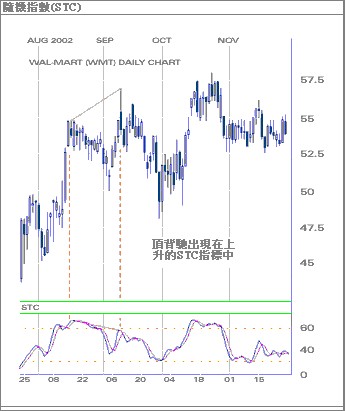
There are two types of divergences: positive and negative. In general, a positive divergence occurs when the indicator advances and the underlying security price declines (below). A negative divergence occurs when an indicator declines while the price advances. Using Indicators To be successful when trading with oscillator signals, trading strategies and analysis should be based from the results of multiple signals. The criteria for a buy or sell signal could depend on, for example, three separate yet confirming signals. For example, a buy signal might be generated with an oversold reading from the RSI, positive divergence, and a bullish moving average crossover. By following a certain set of rules, the trader will be more confident when making the final buy/sell decision while at the same time, reduce the risk of false signals from individual oscillators. Oscillators are also most effective when used in conjunction with chart pattern analysis, support/resistance identification, trend identification, and other technical analysis tools. Interpreting oscillator values and signals vary from situation to situation and thus, by using other analysis techniques in conjunction with oscillator readings, the chances of success can be greatly enhanced. |